
The shift fundraising teams are experiencing
For many fundraising teams, multi-channel strategy is already part of everyday work. Campaigns include email, direct mail, social media, calls, paid media, and additional channels layered over time as new opportunities appear. From an internal perspective, this expansion often signals progress, with broader reach and more touch points across the donor journey. Over time, however, results begin to feel less stable, with performance varying across campaigns and increased effort not always translating into stronger outcomes.
It is common to look for explanations within each channel. Teams adjust email cadence, refine subject lines, revisit direct mail volume, and test digital performance, all in an effort to improve results. These actions are valuable, yet they do not fully account for the inconsistency many organizations experience. The underlying shift lies in how channels connect and how donors experience that connection.
Multi-channel fundraising results and data
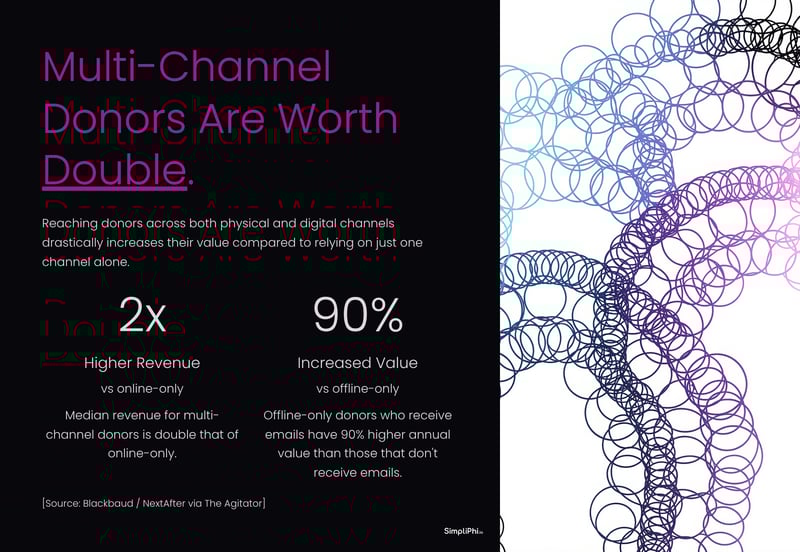
Research consistently shows that donors who engage across multiple channels generate stronger results. Data from Blackbaud and NextAfter (via The Agitator) shows that multi-channel donors can produce up to 2x the revenue of those who interact through a single channel, while donors who give offline and also receive email demonstrate 90% higher overall value.
Differences in channel behaviour contribute to this dynamic, with email open rates often around 29% and direct mail reaching between 35% and 90% depending on context. Reducing reliance on one channel does not necessarily improve efficiency. A study by Masterworks Agency found that reducing direct mail volume by 75% for digitally active donors led to a decline in total revenue, reinforcing the role each channel plays in supporting the others.
Donors experience one relationship, not multiple channels
Donors interpret these interactions as part of a single relationship with your organization, even though the internal structures separate communication by channel, with different teams managing different workflows. Each message builds on the previous one, whether it arrives by email, direct mail, or another format.
When communication is misaligned, even small inconsistencies create friction that weakens engagement over time. At SimpliPhi, we help nonprofit organizations build a donor's single relationship with your mission through clear, organized data.
Where execution begins to break down
We know that the gap becomes visible during campaign execution. Audiences are often built manually or across multiple systems, requiring teams to rely on spreadsheets, exports, or internal confirmation before moving forward. Segments may be adjusted late in the process, and uncertainty can arise around who is included, who is excluded, and whether the audience reflects the intended strategy.
That uncertainty is closely tied to trust in audience definition. When teams cannot clearly validate their audiences, even well-designed strategies become difficult to execute consistently. Questions about inclusion, overlap, and segmentation logic introduce friction that affects both timing and performance.
How AmpliPhi supports audience clarity and segmentation
AmpliPhi.app is our segmentation platform designed for nonprofits. It was developed to address this operational gap by focusing on audience clarity and validation. It provides fundraising teams with a structured way to build and adjust segments, confirm inclusion before sending, and make changes without disrupting underlying segmentation logic. Instead of relying on manual verification or waiting for confirmation from multiple sources, teams can move forward with a clear understanding of their audience. Segmentation can be completed up to 10x faster compared to traditional methods, while maintaining hierarchy and preventing duplication across campaigns.
.png?width=1920&height=1080&name=Linkedin%20Newsletter%20(34).png)
What becomes easier for fundraising teams
This shift changes how fundraising campaigns are executed. Teams gain confidence in their audience selection, which allows them to focus more on messaging and timing. Campaigns move forward without last-minute hesitation, and communication becomes more relevant because audiences reflect the actual relationships behind each donor interaction. Time previously spent checking data and reconciling lists is redirected toward planning and execution. Teams move faster while maintaining consistency across channels.
The impact on fundraising performance
Stronger alignment across channels supports more consistent results. Messages reach the right supporters with greater accuracy, reducing the number of missed opportunities caused by incomplete or inconsistent segmentation. Campaign performance improves as relevance increases, and revenue outcomes become more predictable because execution follows a clear and validated structure.
The opportunity within multi-channel fundraising sits in alignment. Channels will continue to evolve and expand, yet the donor experience remains grounded in a single relationship shaped by every interaction. When that relationship is supported by clear and validated audiences, fundraising becomes easier to execute and more effective over time.
When your audience is clear, execution becomes easier. If you’re looking to reduce uncertainty in your campaigns, we’d be happy to walk you through how AmpliPhi works.
Comments