
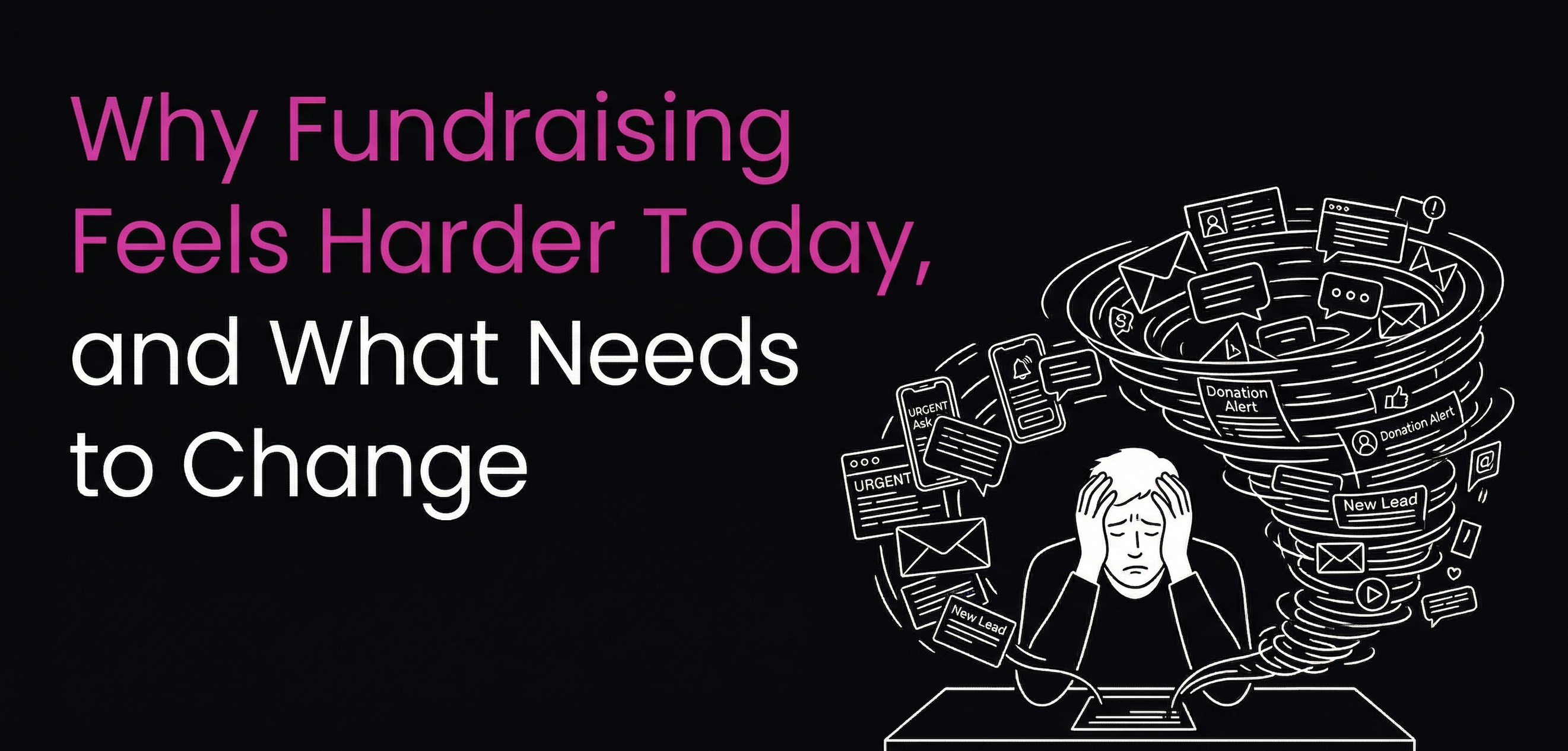
For many nonprofit teams, something has shifted over the past few years.
Campaigns are more frequent, more channels are available, and the tools are more powerful than ever. At the same time, results are becoming less predictable and in many cases, harder to sustain. It creates a strange tension in which effort continues to increase, yet the return does not always follow suit.
It is easy to explain this shift by pointing to external pressure such as donor fatigue, shorter attention spans, and increased competition across every sector.
All of that may be true, but it does not fully explain what is happening.
The deeper shift is in how donors experience communication, and how that experience has quietly diverged from how organizations design it.
Donors are surrounded by messages, including ours
A typical donor today moves through a constant stream of communication. News, social media, brands, personal messages, and nonprofit outreach all compete within the same space.
Within the nonprofit sector, this pressure has also increased. Organizations are sending more emails year over year, with an increase of about 9% from 2023 to 2024, reaching an average of 62 messages per subscriber annually, while many still do not actively remove unengaged contacts from their lists, with about 38% of organizations continuing to send to inactive audiences, according to M+R Benchmarks 2025 and Nonprofit Tech for Good.
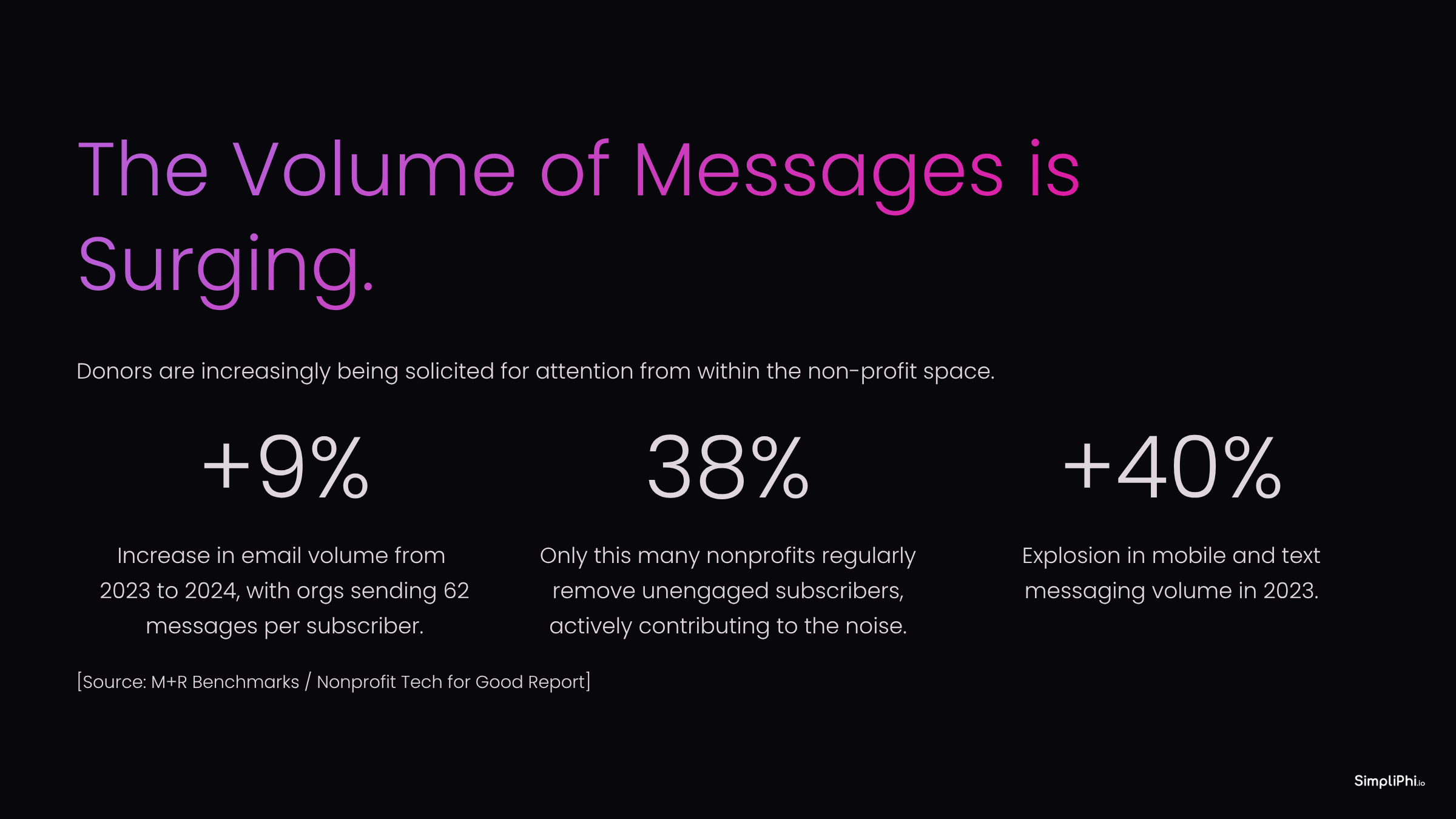
At the same time, newer channels such as SMS have grown rapidly, with increases of around 40%, according to M+R Benchmarks, adding additional layers of communication rather than replacing existing ones.
From an internal perspective, this can look like growth and increased reach.
From the donor’s perspective, this growing mix of emails, SMS, ads, and outreach across their entire day, from multiple organizations and other sources, often feels like repetition without differentiation.
When messages from many organizations and channels start to sound similar across a donor’s day, attention becomes harder to earn, and even harder to keep.
Relevance has become the deciding factor
When response rates begin to decline, the instinct is often to increase activity. More campaigns, more touchpoints, more opportunities to engage.
What is often missed is that donors are not withdrawing because they are hearing too much. They are withdrawing because what they are hearing does not reflect their own context.
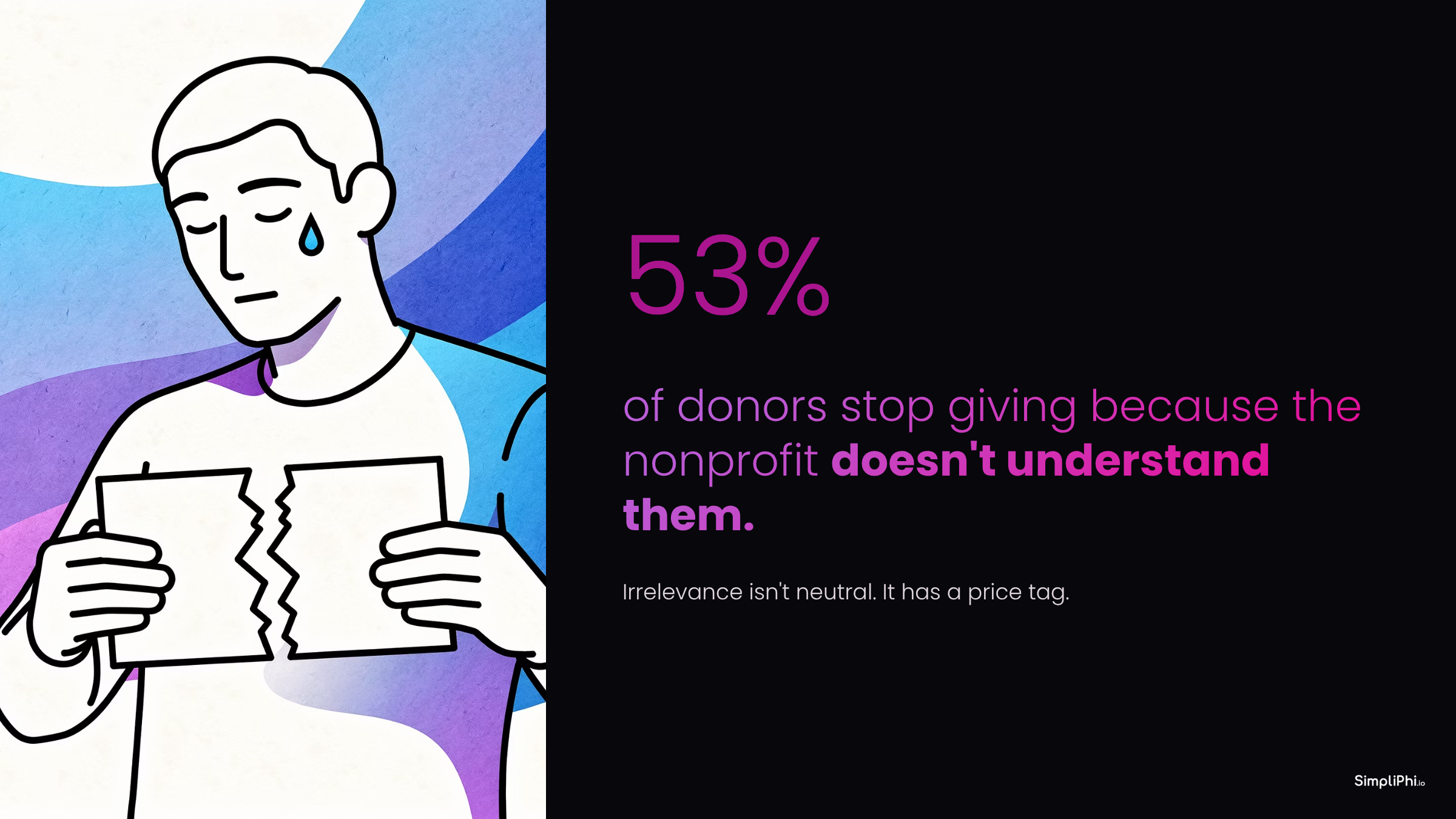
More than half of donors who stop giving, around 53%, report that they did not feel understood by the organization, according to 2026 Email Marketing Statistics for Nonprofits.
 At the same time, nearly three-quarters of consumers, close to 75%, engage only with communication that feels personalized to them.
This points to a gap between how communication is structured and how it is received.
Many fundraising campaigns are still built around internal workflows, campaign calendars, and channel ownership. Donors, on the other hand, interpret every interaction through their personal relationship with the cause.
The distance between those two perspectives is where disengagement begins.
Donors experience one relationship, not multiple channels
Inside most organizations, communication is divided by function. Direct mail is planned by one team, email by another, digital by a third, and events operate on their own timeline.
This structure is necessary for execution.
However, donors do not see these divisions. What they experience is a continuous relationship with your organization.
When communication is not aligned across channels, even small inconsistencies can create friction. A donor might receive a highly personalized letter and then a generic email that does not acknowledge the same context. Both messages may be accurate, but together they do not feel connected.
Over time, this lack of continuity weakens trust and reduces engagement.
Organizations that are seeing stronger results are not simply increasing volume. They are aligning their communication so that each message builds on the previous one, regardless of where it appears.
Segmentation has become a foundation, not an enhancement
Segmentation has been part of fundraising for a long time, usually used to refine targeting or test different approaches.Today, it simply plays a much bigger role. It shapes how you understand your donors and how you communicate with them, especially at scale where not everyone should be treated the same.Donors come in with very different motivations for giving, and those motivations shape how they read and respond to your communication.A first-time donor may have responded to a specific moment. A long-time supporter is acting from a deeper, ongoing connection. Someone who gave in memory of a loved one is responding to a personal situation. A peer-to-peer donor may have simply supported a friend who asked.
These starting points are not the same, and when they are treated the same way, communication quickly starts to feel generic.
This is where segmentation becomes practical. It allows you to reflect the actual relationship behind the gift instead of treating everyone as part of one group.
The complexity behind new donors is often underestimated
New donors are often seen as a sign of growth, and in many ways, they are. They can represent close to 38% of a donor base within a year, and when including those who make a second gift, that portion can grow to 47%, according to the Fundraising Effectiveness Project.
At the same time, only about 14% of them will give again, according to the Fundraising Effectiveness Project. The reason sits in how these donors enter your organization.
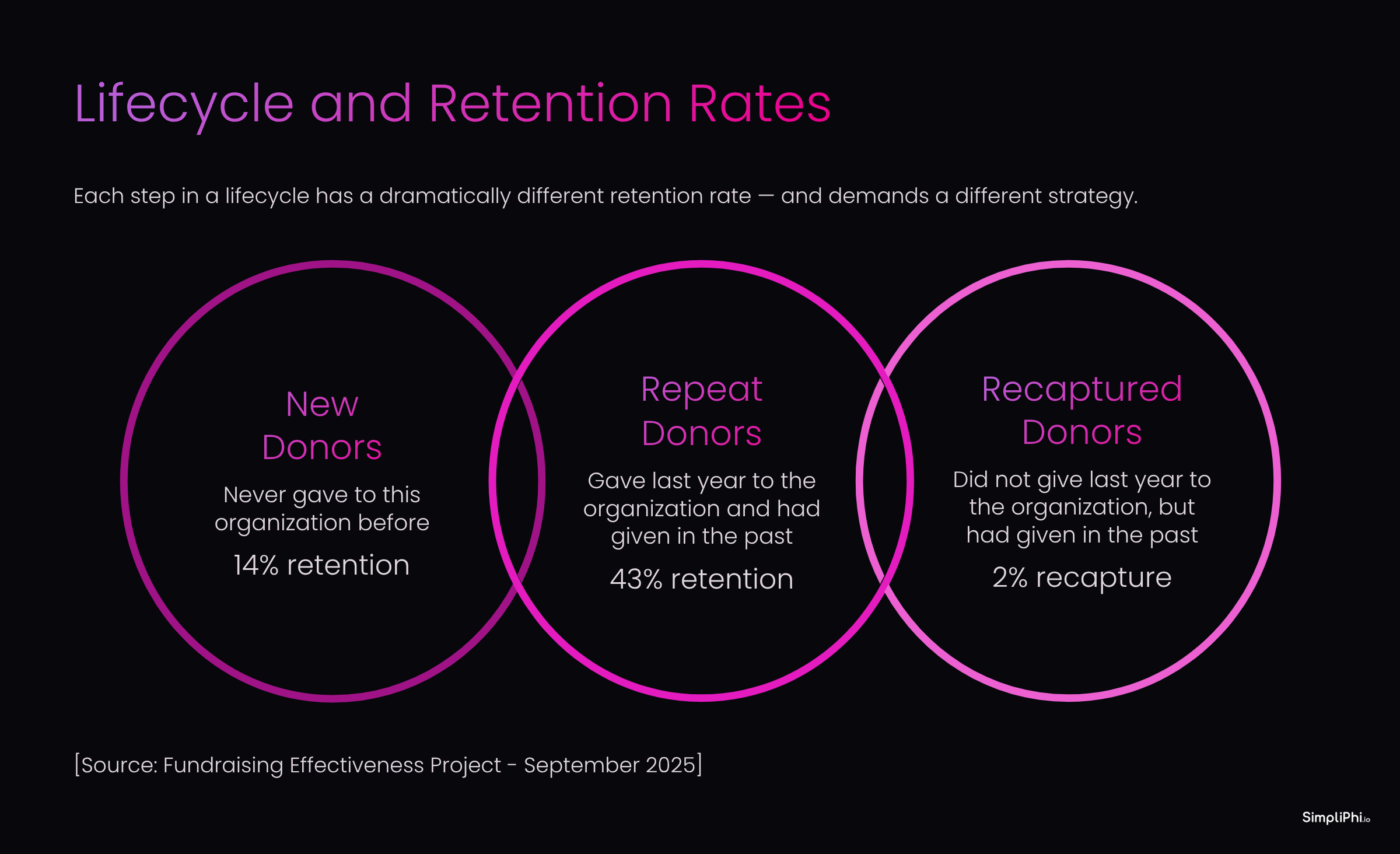 Many are not responding to your mission directly. They are responding to a moment, a person, or an experience. A friend asked them to give. They attended an event. They wanted to honor someone.
The connection is real, but it is often tied to a specific moment or person rather than your organization.
If that starting point is not acknowledged and developed in future communication, the relationship does not deepen, and many of these donors do not return.
Retention tells a clearer story than acquisition
The economics of fundraising have been consistent for a long time.
Retaining a donor costs significantly less than acquiring a new one, often by a factor of 10x. Repeat donors make up roughly 40% of the donor base and contribute more than 60% of total revenue, with retention rates around 43%.
At the same time, lapsed donors become increasingly difficult to re-engage. After two years without giving, the likelihood of reactivation drops to around 2%, meaning that 98% will not return.
These numbers are widely understood.
What is more difficult is acting on them consistently, especially when segmentation becomes complex and operationally demanding.
Multi-channel communication strengthens connection when it is coordinated
Reaching donors through multiple channels increases the likelihood of engagement as each channel reinforces the same message over time.
Email open rates for nonprofits are often around 29%, while direct mail open rates range between 35% and 90%. When both are used together, they increase the chances that a donor will encounter the message at the right moment.
Donors who are engaged across multiple channels tend to have significantly higher value, often generating up to 2x the revenue of those who engage through a single channel, according to Blackbaud and NextAfter, reported via The Agitator (DonorVoice).
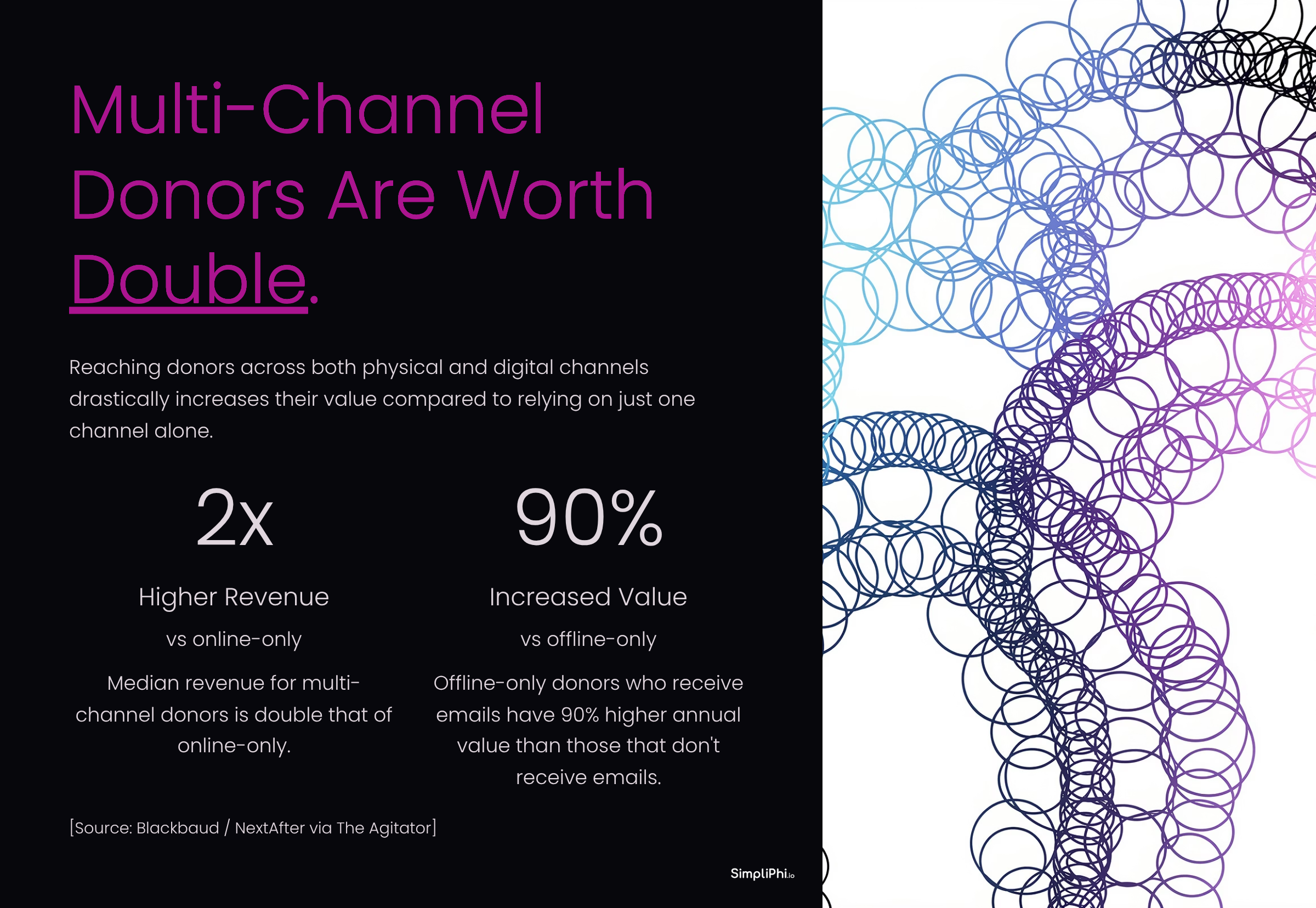 The benefit comes from consistency and repetition, not from channel expansion alone.
When the same story is carried across channels, it becomes recognizable and easier to engage with. When channels operate independently, that effect is lost.
Many missed opportunities come from good intentions
Some of the most common gaps in fundraising come from decisions made to protect the donor experience. For example, someone gives once through a single channel, such as an event or an email appeal, and then is not invited into other parts of the organization’s communication or activities.
Donors who have already given earlier in the year are sometimes excluded from additional asks. Peer-to-peer donors are sometimes left untouched after an event. In-memory donors may remain in general communication streams long after their initial context has passed.
These decisions often come from a place of caution.
In practice, they can limit engagement.
Donors are not deciding in isolation whether to give again. They are responding to what they see and what they are asked. If they are not hearing from you, they are likely hearing from someone else.
Giving them the opportunity to engage does not create pressure. It maintains the relationship.
The challenge is no longer strategy, but execution
At this point, most organizations understand the importance of segmentation, personalization, and multi-channel communication.
The difficulty lies in making it work in practice.
Segmenting donors based on behavior, motivation, giving level, and relationship requires more than simple queries or reports. Coordinating those segments across channels requires structure. Ensuring that each donor appears once, in the right segment, with the right message, requires precision.
Without the right systems, this process becomes time-consuming and difficult to maintain, which often leads to simplification and loss of nuance.
This is where many strategies begin to break down.
Moving from insight to action
As fundraising continues to evolve, the organizations that will perform best are those that can translate understanding into execution without losing consistency.
This requires a shift from thinking in campaigns to thinking in systems that support relationships over time.
It also requires tools that are designed for this level of complexity, tools that free up time for teams to think about strategy instead of spending hours working through spreadsheets and building queries.
.png?width=800&height=450&name=Linkedin%20Newsletter%20(34).png)
AmpliPhi.app was built with this challenge in mind. It connects directly with CRM platforms like Raiser's Edge NXT or Salesforce and provides a structured way to segment donor audiences, assign messaging, and coordinate campaigns across channels with clarity and control.
Instead of managing segmentation manually, teams can build hierarchical segments, apply consistent logic, and ensure that each donor is included once, in the right place, with the right context. Segmentation workflows can be completed up to 10x faster, allowing teams to move from planning to execution without losing momentum, based on platform benchmarks presented in the segmentation workshop.
The goal is not to change how organizations think about fundraising, but to make it possible to execute that thinking at scale.
Because as communication becomes more complex, the ability to stay relevant depends less on how much is sent, and more on how well each message reflects the person receiving it. If you want to see how this can work in practice, you can book a demo of AmpliPhi to explore how segmentation can be applied across your campaigns.
Comments