3 min read

Why Donors Who Give the Same Amount Need Different Strategies

For many fundraising teams, donor segmentation is already part of everyday work. Donors are grouped by campaign, giving level, or recency, and these structures help organize outreach across channels and appeals. From an internal perspective, this creates clarity, with each group representing a defined audience and a clear execution path.

Over time, however, something begins to feel inconsistent. Campaigns that are carefully planned and properly segmented still yield uneven results, and donors who appear similar on paper respond in very different ways. Two donors may give the same amount through the same campaign at the same time, yet for completely different personal reasons.

Linkedin Newsletter (48)

What is often assumed is that these differences can be resolved through more data or more detailed segmentation. Teams refine filters, add attributes, and adjust logic in an effort to better define their audiences. These actions are valuable, yet they do not fully explain why similar "in data" donors behave so differently, and the underlying difference is not in the data itself, but in the reason behind the gift.

The real driver behind donor behaviour: affinity, not amount

Many of your new donors do not begin their relationship with an organization directly. In peer-to-peer and in-memory giving, the motivation is often personal. Donors give to support a friend or a family member, and the organization is secondary in that moment. From an internal perspective, these donors are recorded as new supporters. From their perspective, they may not yet feel connected to the mission.

This is where the affinity gap becomes visible. We believe that donors might differ by their level of connection to the cause. Some begin with low affinity, where the relationship is tied to an individual rather than the organization. Others, such as grateful patients, have a more direct but still situational connection. At the other end are repeat donors who are deeply engaged and consistently support the mission. These differences shape how donors respond to communication, how they engage over time, and ultimately how likely they are to give again.

What happens when all donors are treated the same?

When these distinctions are not reflected in segmentation, communication begins to feel misaligned. A message that resonates with a long-term supporter may feel distant to a peer-to-peer donor. A message designed for a broad audience may overlook the context that originally motivated the gift.

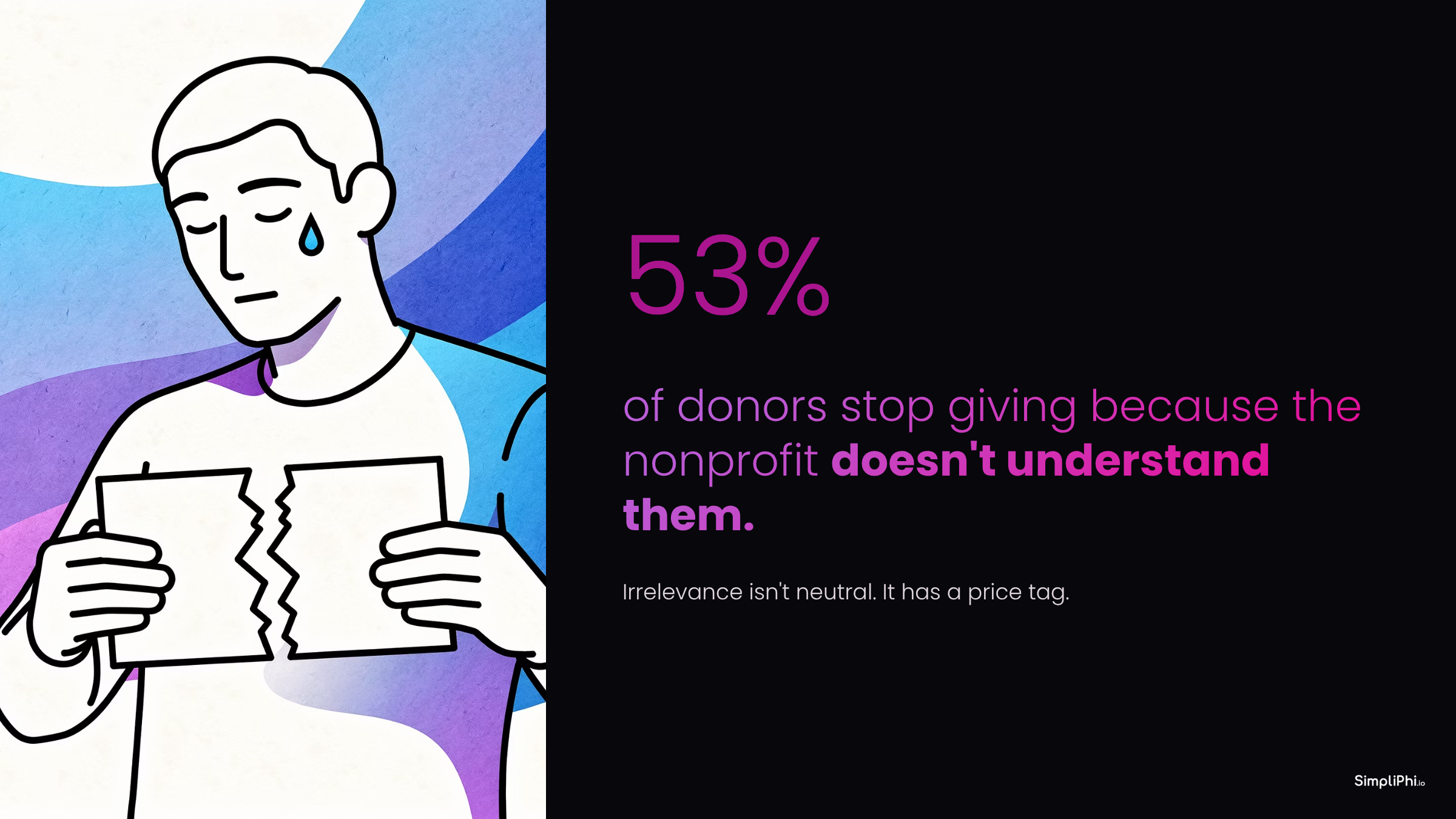
This affects more than campaign performance. It shapes how donors experience their relationship with the organization. Data from 2026 Email Marketing Statistics for Nonprofits shows that 53% of donors stop giving because they do not feel understood by the organization. This highlights a direct link between personalization, donor retention, and long-term fundraising performance. Relevance is the baseline expectation of your donors.

53percent

Why data alone does not improve donor segmentation

At the same time, many nonprofit teams already have access to significant amounts of donor data. The challenge is not access, but clarity. Data often exists across multiple systems, and alignment is not always guaranteed. As a result, teams spend time validating lists, reconciling numbers, and confirming whether audiences reflect the intended strategy. Instead of enabling faster execution, data can introduce hesitation, delay campaigns, and limit confidence in decision-making. Without clarity, data slows teams down instead of moving them forward.

The 2-year rule: why most reactivation campaigns underperform

This challenge becomes even more visible in donor reactivation efforts. According to the Fundraising Effectiveness Project – September 2025, donors who have not given in more than two years are approximately 98% unlikely to give again. At the same time, reactivation success rates remain around 2%, even though these campaigns continue to consume time and resources.

In practice, many reactivation strategies focus on reaching more donors, rather than selecting the right donors. A donor who gave consistently over several years carries a very different likelihood of returning than someone whose gift was tied to a specific moment or individual. Without this distinction, reactivation becomes less efficient and more difficult to sustain. Smart reactivation is based on the idea of selecting the right donors to re-engage.

Rethinking donor segmentation: from data to intent

Across all of these areas, a consistent pattern emerges. Donor segmentation is often treated as a technical exercise, focused on grouping donors based on available data. In reality, its value comes from understanding the context behind each gift and translating that context into communication that feels relevant. The question shifts from: "How much did this donor give?" to "Why did this donor give?"

When communication reflects that original motivation, the relationship can develop naturally over time. When that context is missing, even well-executed campaigns can feel disconnected.

How AmpliPhi helps nonprofit teams improve segmentation and execution

AmpliPhi.app supports this shift by helping teams move from surface-level segmentation to a clearer understanding of their audiences. By structuring and validating donor data, it becomes easier to see how different groups should be approached and how their relationship with your mission evolves over time.

The goal is not to add complexity, but to make segmentation more meaningful while simplifying the underlying logic. With AmpliPhi, teams often reduce the number of segments and focus their efforts on the ones that truly drive results. This creates space to execute campaigns with greater confidence, knowing that audiences reflect real donor relationships.

As Sylvie Riendeau, Vice-President, Communications & Marketing at the Montreal General Hospital Foundation, explains, “Each new segment requires tailored content and operational effort. With AmpliPhi, the focus remains on strategic segmentation that adds real value, rather than complexity for its own sake.”

If you’re looking to bring more clarity to your segmentation and reduce the time spent validating data, we’d be happy to show you how AmpliPhi works in practice. 


Why Fundraising Feels Harder Today and How Nonprofits Can Improve Donor Retention

6 min read

Why Fundraising Feels Harder Today and How Nonprofits Can Improve Donor Retention

For many nonprofit teams, something has shifted over the past few years. Campaigns are more frequent, more channels are available, and the tools are...

Read More
2026 Fundraising Trends: What the Pulse of the Donor Report Reveals About Mobile and Recurring Giving

3 min read

2026 Fundraising Trends: What the Pulse of the Donor Report Reveals About Mobile and Recurring Giving

What changed in donor behavior in 2025, and why it matters in 2026 Fundraise Up’s Pulse of the Donor 2026 report describes 2025 as a “paradox year”...

Read More
First-Time Donor Segments for Hospital Foundations: A Practical Guide to Segmentation, Retention, and Revenue Growth

3 min read

First-Time Donor Segments for Hospital Foundations: A Practical Guide to Segmentation, Retention, and Revenue Growth

Hospital foundations are investing more time and resources into fundraising than ever before, yet many teams continue to face the same challenge:...

Read More
Multi-Channel Donors Are Worth 2x

3 min read

Multi-Channel Donors Are Worth 2x

The shift fundraising teams are experiencing For many fundraising teams, multi-channel strategy is already part of everyday work. Campaigns include...

Read More
Exploring an Omatic Alternative: What Nonprofits Should Consider About Data Integration

6 min read

Exploring an Omatic Alternative: What Nonprofits Should Consider About Data Integration

Fundraising teams depend on accurate, timely, and complete data to make decisions, execute campaigns, and report results. Yet for many nonprofit...

Read More
Donor Segmentation Strategies for Nonprofits: Stop Second-Guessing Your Campaign Lists

4 min read

Donor Segmentation Strategies for Nonprofits: Stop Second-Guessing Your Campaign Lists

Donor segmentation strategies for nonprofits can determine whether a campaign exceeds its goal or quietly underperforms. For Communications and...

Read More
Donor Segmentation for Nonprofits: A Smarter Refresh Logic for Better Campaign Control

4 min read

Donor Segmentation for Nonprofits: A Smarter Refresh Logic for Better Campaign Control

We are changing the refresh logic in AmpliPhi so that updates only apply to the object you are working on, rather than automatically recalculating...

Read More
Luminate Online and Raiser’s Edge NXT Integration: How Trillium Health Partners Foundation Improved Donor Data Accuracy

3 min read

Luminate Online and Raiser’s Edge NXT Integration: How Trillium Health Partners Foundation Improved Donor Data Accuracy

Modern fundraising organizations operate in increasingly complex environments, where multiple systems, teams, and channels must work together...

Read More