
Hospital foundations are investing more time and resources into fundraising than ever before, yet many teams continue to face the same challenge: first-time donors are entering the organization consistently, but very few are becoming long-term supporters.
According to the Fundraising Effectiveness Project (FEP), first-time donors can represent up to 38% of a donor base, yet only about 14% will go on to make a second gift, creating a significant gap between acquisition and retention that directly affects long-term fundraising revenue.
In many cases, this gap is caused by a mismatch between why donors gave in the first place and the communication they receive afterward. Many organizations continue to treat first-time donors as a single audience, even though these donors often arrive through very different experiences, relationships, and motivations. Over time, this creates communication that may be accurate from an organizational perspective, but disconnected from the donor’s actual reason for giving, which is where relevance begins to decline and retention begins to weaken.
According to the same research, more than half of donors, approximately 53%, stop giving because communication does not feel relevant to them, which reflects not a lack of generosity, but a lack of connection between the message and the individual receiving it.
This is where segmentation begins to play a different role than it has historically, shifting from a tactical refinement into a foundational element of how relationships are understood and maintained over time.
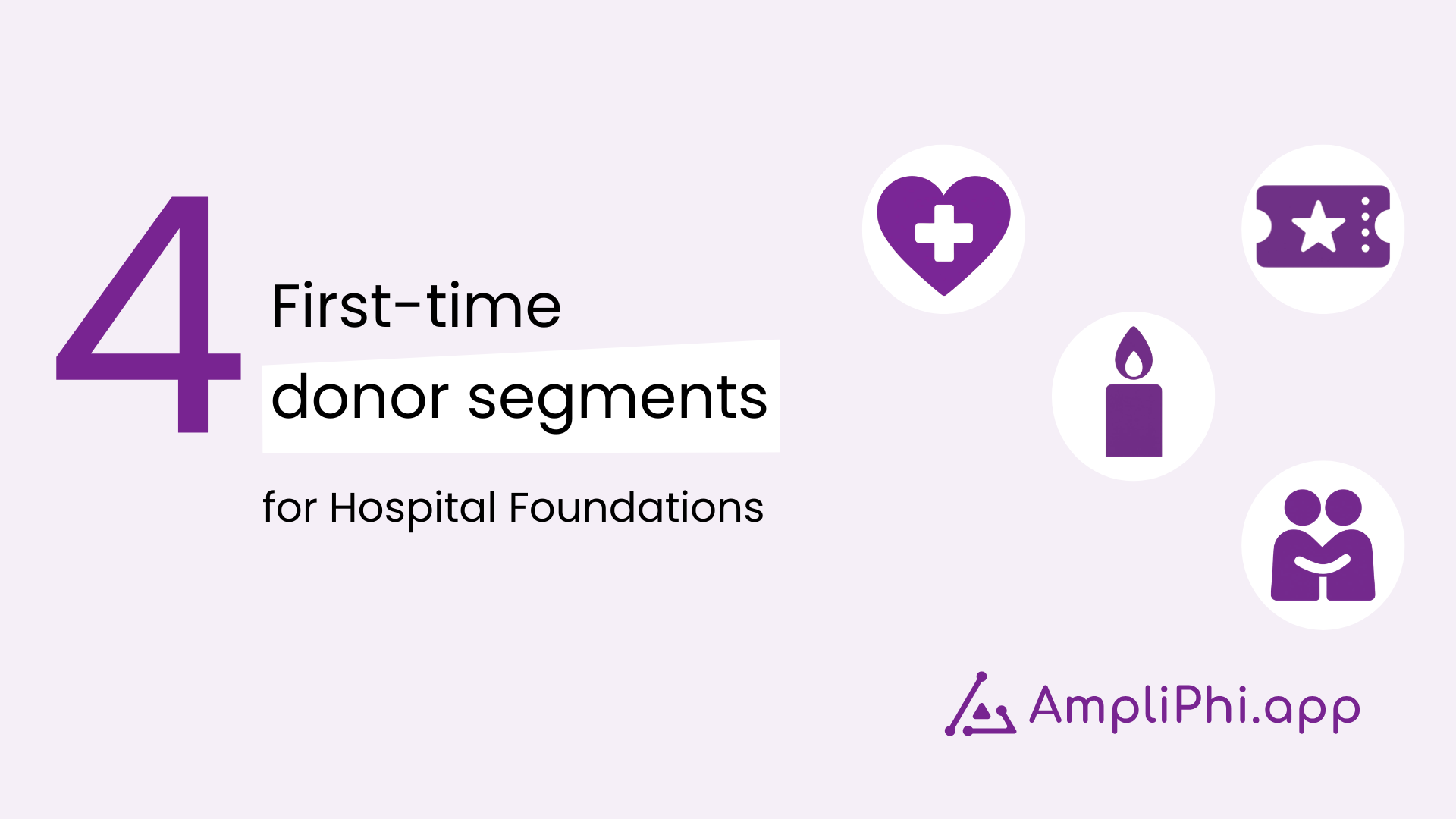
Four First-Time Donor Segments in Hospital Foundations
Within hospital foundations, these patterns tend to appear in consistent ways, where the same action, a first gift, can be traced back to very different motivations that shape how communication should evolve.
.png?width=1920&height=1080&name=Linkedin%20Newsletter%20(58).png)
1. Grateful Patients
A grateful patient often enters the relationship through a deeply personal experience of care, where the initial gift functions primarily as an expression of gratitude rather than as a direct commitment to the broader mission of the organization.
In this case, the donor already has a meaningful emotional connection, but it is tied to a personal experience. As communication continues, the relationship begins to shift, requiring a transition to helping others receive similar care.
2. Peer-to-Peer Donors
From an operational perspective, they appear as first-time donors within the system, yet from their perspective, the relationship may still exist almost exclusively with the individual they supported.
The communication challenge becomes one of redirection, where the organization gradually connects that original action to the broader impact it enabled.
3. Tribute and In-Memory Donors
Unlike donors who intentionally seek out a mission to support, these donors frequently enter through circumstance, which means the opportunity to build long-term affinity exists within a relatively narrow timeframe.
Communication in this context needs to help donors understand the impact created through their gift while gradually introducing the broader work of the organization.
4. Event Participants
Event participants represent another distinct segment, where the connection is often tied more closely to the experience itself than to the mission behind it.
The opportunity lies in connecting the positive experience of participation to the real impact that participation helped create. When that connection is not made early, and when no additional engagement follows within the next 12 to 24 months, the relationship often remains attached to the event itself.
The Execution Gap in Donor Segmentation
While this relationship between segmentation, relevance, and retention is widely understood in principle, the challenge often lies in executing it consistently across real-world systems and workflows, where data may be fragmented, segments may be built manually, and campaigns may be coordinated across channels that operate independently. This is why we created AmpliPhi.app: to help hospital foundations turn segmentation into a clear, repeatable part of donor communication.
AmpliPhi.app is a nonprofit segmentation platform which helps to organize donor audiences, validate who is included in each campaign, and coordinate communication across channels with clarity. By connecting directly with CRM systems such as Raiser's Edge NXT and Salesforce, and enabling segmentation based on real donor behaviour and context, it allows teams to move away from spreadsheets and manual list-building toward a more reliable execution model, where each donor can be included once, in the right segment, with the appropriate message.
As communication becomes more aligned with the donor’s perspective, relationships develop with greater consistency, and over time, those relationships become the foundation on which long-term revenue is built.
.png?width=800&height=450&name=Linkedin%20Newsletter%20(34).png)
Key takeaways for hospital foundation teams
-
First-time donors are not one audience, and their motivations directly influence how they respond to communication.
-
Segmentation is no longer a tactical improvement, but a foundational capability that shapes retention and revenue.
-
Understanding why donors give allows hospital foundations to design communication that feels relevant, timely, and aligned with each donor’s experience.
-
A segmentation platform such as AmpliPhi.app ensures that each campaign is built on accurate, validated audiences, reducing last-minute uncertainty and allowing teams to move forward with confidence.
-
With the right structure in place, hospital foundations can move from one-time gifts to sustained donor relationships, improving both engagement and long-term fundraising performance.
Comments